Find an EV Charging Station Near You
Summary
You can find a nearby EV charger with Google Maps, PlugShare, the US Department of Energy station locator or charging network apps. Before you go, check connector compatibility, charging speed, availability and payment options, because not every station works with every electric vehicle.
Finding an electric vehicle (EV) charging station near you is easier when you know which maps, apps, and charging networks to use. Whether you need a quick charge during a commute or a reliable stop on a long road trip, several tools can help you locate nearby stations and check their features.
However, not every charging station works with every electric vehicle. Charging speed, connector compatibility, availability, and payment options can also vary by location. Here is how to find a suitable EV charger in your area and what to check before heading there.
How to Find EV Charging Stations Near You
You can use navigation apps, dedicated charging maps, and vehicle infotainment systems to locate public charging stations. For more accurate results, check the station details through the charging network's own app before starting your trip.
1. Google Maps
Google Maps can help you locate nearby public EV charging stations. Search for terms such as "EV charging stations near me" or "electric vehicle charging," then review the available locations.
Depending on the station and available listing information, you may see:
-
Station addresses and directions
-
Business hours and user reviews
-
Charging connectors and supported plugs
-
Photos and location details
Google Maps is convenient for finding stations during everyday travel. However, real-time charger availability and detailed charging information may not be available for every location.
2. PlugShare
PlugShare is a dedicated EV charging locator that displays charging locations across different networks. Drivers can use its map and filters to find stations compatible with their vehicles.
Useful features include:
-
Filters for connector types and charging speeds
-
Station reviews, photos, and driver comments
-
Information about available amenities
-
Availability details where supported
-
Route-planning tools
PlugShare is particularly helpful when comparing multiple charging locations. Its driver-submitted information can also provide useful context about station access and reliability.
3. U.S. Department of Energy Station Locator
The Alternative Fuels Data Center (AFDC) Station Locator is a government resource for finding public EV charging stations across the United States.
You can search by city, ZIP code, or address and narrow results using available filters. These include charging network, connector type, charging level, and other station details.
This tool is useful when you want to compare public charging locations from different providers rather than search within a single network.
4. Charging Network Apps
Major charging networks offer their own apps and station maps. These can provide more specific information about their chargers, including power output, pricing, and availability.
Some widely used options include:
-
Tesla Supercharger: Locate Supercharger stations and check access for compatible vehicles. Non-Tesla access depends on the vehicle and individual station.
-
Electrify America: Find charging locations, review charger information, and check availability through its app.
-
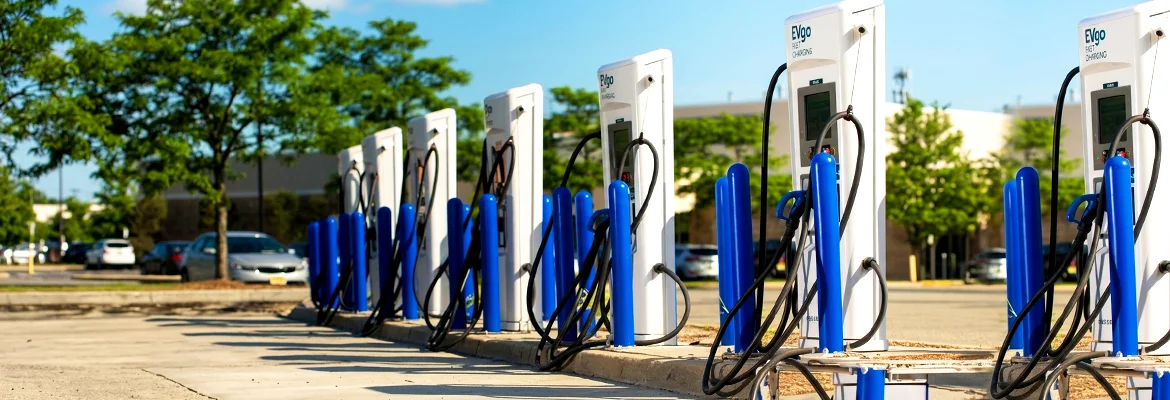
EVgo: Search for EVgo charging stations and review location information.
-
ChargePoint: Find public charging locations and access station details through its app.
Before driving to a station, check its network app for the latest information. A location appearing on a map does not necessarily mean every charger is operational or available.
Types of EV Charging Stations
Public EV chargers generally fall into three categories: Level 1, Level 2, and DC fast charging. Each provides a different charging speed and serves different driving needs.
Level 1 Charging
Level 1 charging uses a standard 120-volt AC outlet in the United States. It is the slowest charging option and is primarily used at home or where a suitable outlet is available.
A typical Level 1 charger adds approximately 2 to 5 miles of driving range per hour, depending on the vehicle and charging conditions. It is generally unsuitable for drivers who need a quick charge during a trip.
Level 2 Charging
Level 2 charging uses 208-volt or 240-volt AC electrical service. It is common at homes, workplaces, shopping centers, parking facilities, and some public charging locations.
Depending on the charger and vehicle, Level 2 equipment can add approximately 10 to 30 miles of range per hour. It is a practical option when a vehicle will remain parked for several hours.
DC Fast Charging
DC fast charging supplies direct current to an EV battery and provides significantly faster charging than Level 1 or Level 2 equipment. These chargers are commonly found along highways and at dedicated public charging locations.
Depending on the vehicle and charger, DC fast charging can add approximately 100 to 200 or more miles of range in 30 minutes. Some compatible vehicles and high-powered chargers can deliver faster results.
Charging speed usually decreases as the battery approaches a high state of charge. For this reason, drivers on long trips often charge to around 80% before continuing rather than waiting for a full battery.
Major EV Charging Networks in the United States
| Charging Network | Main charging options | What drivers should know |
|---|---|---|
| Tesla Supercharger | DC fast charging | Access for Tesla and selected non-Tesla vehicles, depending on station and compatibility |
| Electrify America | DC fast charging | Offers high-power charging at many highway and urban locations |
| EVgo | DC fast charging | Operates public fast-charging locations in multiple states |
| ChargePoint | Primarily Level 2, with DC fast charging locations | Provides access to a broad network of public and workplace chargers |
| Blink Charging | Level 2 and DC fast charging | Offers charging at public, commercial, and residential locations |
Some charging networks also share station information through third-party apps and maps. Coverage can change as new stations open and existing locations are upgraded.
For the most accurate information, use the network's official locator or app to confirm the address, connector, power output, and current operating status.
How to Choose the Right EV Charging Station
The closest charging station is not always the best option. Before selecting a location, consider these factors.
Check Connector Compatibility
Your EV must support the connector available at the charging station. In North America, common connector standards include:
-
J1772: Commonly used for Level 1 and Level 2 AC charging.
-
CCS: Used for DC fast charging on many EV models.
-
NACS (SAE J3400): Used by Tesla and increasingly adopted by other automakers.
-
CHAdeMO: Found on certain older EV models and some public DC fast chargers.
Some vehicles can use charging stations with different connectors through an approved adapter. However, compatibility depends on the vehicle, charging equipment, and adapter. Check your owner's manual before relying on one.
Compare Charging Speeds
Look at the charger's power output, measured in kilowatts (kW). A higher-rated charger does not automatically mean your vehicle will charge at that speed.
The vehicle's maximum charging capability, battery temperature, current battery level, and station power availability all affect the actual charging rate.
Check Availability and Operating Hours
A station may appear on a map even when its chargers are occupied, offline, or restricted. Check real-time availability through the network app whenever possible.
Also review access restrictions. Some chargers are located in private parking facilities, apartment complexes, hotels, or businesses that limit use to customers, residents, or employees.
Review Pricing and Payment Options
Public charging costs vary by network and location. Some stations charge by kilowatt-hour (kWh), while others use time-based pricing or additional session fees.
Membership plans may offer lower rates, but they are not always necessary. Review the displayed price, payment requirements, and any idle fees before starting a charging session.
Tips for Finding EV Charging Stations on Road Trips
Finding a charger nearby is relatively simple in urban areas, but long-distance travel requires more planning. Charging locations can be less frequent on rural highways and remote routes.
Use these tips to make charging stops easier to manage:
-
Plan charging stops before departure: Identify stations along your route instead of waiting until your battery is low.
-
Keep a backup location: Choose an alternative station in case your preferred stop is occupied or out of service.
-
Check charger power: Select charging speeds your vehicle can use effectively.
-
Allow for changing conditions: Cold weather, high speeds, elevation changes, and heavy loads can reduce driving range.
-
Use your vehicle's navigation system: Many EVs can estimate battery consumption and recommend charging stops based on your destination.
-
Check station access: Confirm operating hours, parking restrictions, payment methods, and connector availability.
If you are planning a longer journey, our guide to longest-range electric vehicles for long drives can help you understand how vehicle range affects travel planning.
Final Thoughts
Finding an EV charging station near you is easier with the right maps and charging apps. Compare nearby locations, confirm connector compatibility, check charger availability, and review pricing before setting out. For longer trips, plan charging stops in advance and keep an alternative location in mind.
If you are relocating or need to move your vehicle over a long distance, you can also explore vehicle shipping services as an alternative to driving it yourself.